
By Frontline Africa | October 17, 2026
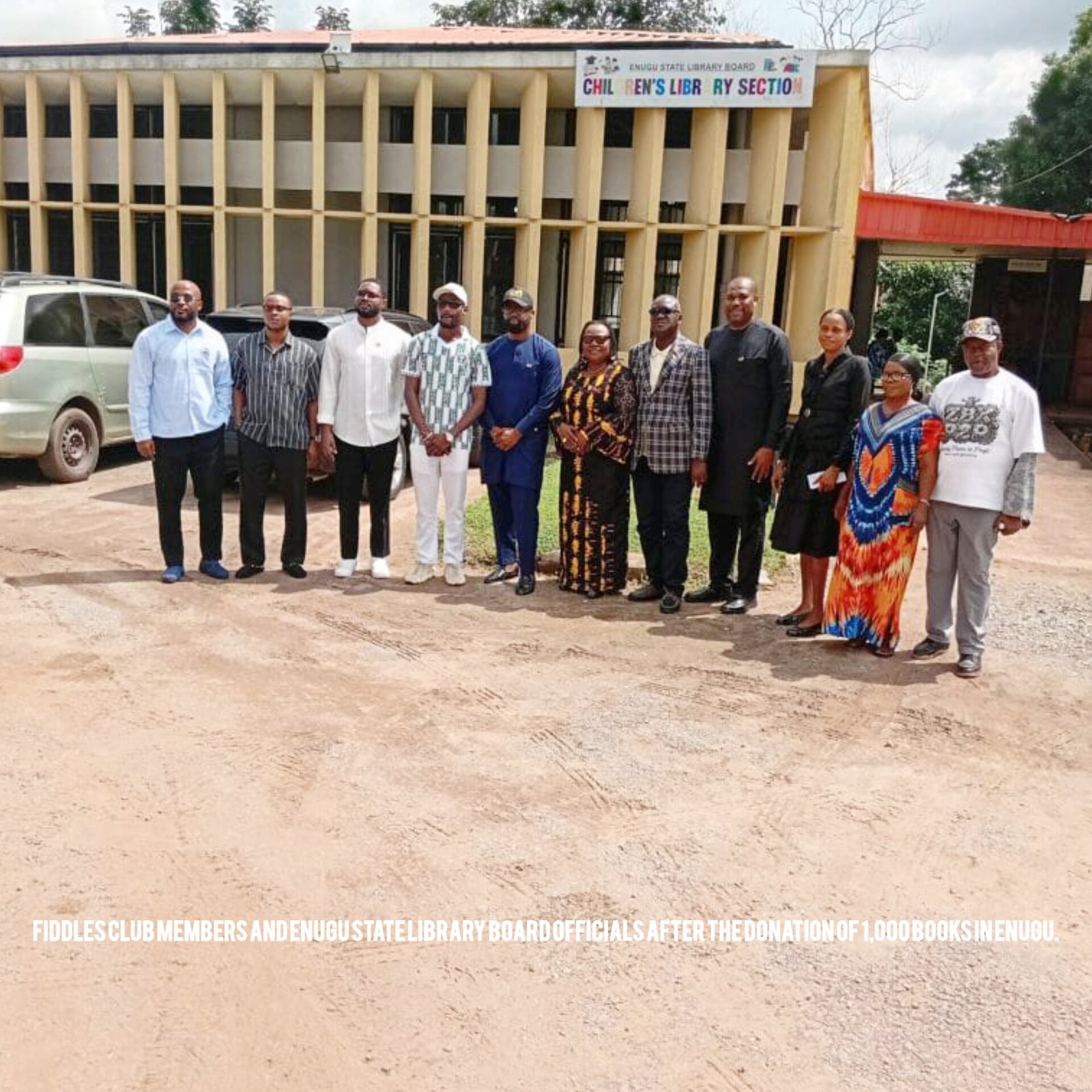
Fiddles Club, an alumni group of the Enugu State University of Science and Technology (ESUT), has donated 1,000 branded exercise books to the Enugu State Library Board as part of efforts to promote literacy and support education in the state.
The group also pledged to donate two sets of textbooks written by indigenous Igbo authors to encourage children to appreciate their cultural heritage and strengthen their connection to their roots.
Speaking during the presentation in Enugu on Friday, the club’s President, Mr Raluchukwu Onwubuemeli, described the donation as a starting point for further educational interventions.
Onwubuemeli said the initiative was a “pipeline for more support”, adding that the club intended to extend similar assistance to other educational institutions.
He expressed the group’s willingness to collaborate with organisations promoting education, including the Enugu State Ministry of Education.
According to him, members of the club benefited from quality education and considered it important to give back to society by supporting the learning needs of children.
He explained that their experiences of living and studying in Enugu had significantly influenced their lives and strengthened their commitment to the development of the state.
Receiving the materials, the Executive Secretary of the Enugu State Library Board, Mrs Sylvia Onwubuemeli, commended the club for the donation, describing the gesture as “a great pleasure”.
She said the exercise books would be distributed across the state, with particular attention to rural communities and zonal libraries.
The executive secretary also commended Governor Peter Mbah for interventions aimed at improving the environment surrounding the library complex.
According to her, the administration has cleared the surrounding areas of criminal activities, fenced the complex and implemented measures that have helped reduce traffic congestion along the adjoining major road.
She, however, appealed for additional support to modernise the library’s operations, expand its collection of books and provide recreational facilities for children.
Onwubuemeli identified the digitalisation of library services, particularly book borrowing, as an important step towards improving access and service delivery.
She also called for more Nigerian and international publications to broaden readers’ knowledge and provide access to diverse educational resources.
The executive secretary disclosed that the library recorded approximately 200 users monthly, with patronage increasing during school holidays.
She explained that periods preceding major examinations, including those conducted by the Joint Admissions and Matriculation Board (JAMB) and the West African Examinations Council (WAEC), usually attracted more visitors.
“Periods leading up to the Joint Admissions and Matriculation Board (JAMB) and West African Examinations Council (WAEC) examinations also attract more clients,” she said.
Onwubuemeli observed that although digital technology had changed reading habits, physical books remained essential to children’s intellectual development.
She said printed materials could help children maintain concentration and develop stronger reading habits, despite the growing preference for reading on mobile phones.
Also speaking, a member of Fiddles Club, Mr Ikenna Anekwe, described the donation as a positive beginning.
Anekwe assured the library board that the club would continue providing assistance within its capacity.
Similarly, a library user identified as Mildred welcomed the initiative, saying the exercise books would support pupils’ educational needs.
She added that donations of learning materials could motivate children to improve their academic performance.