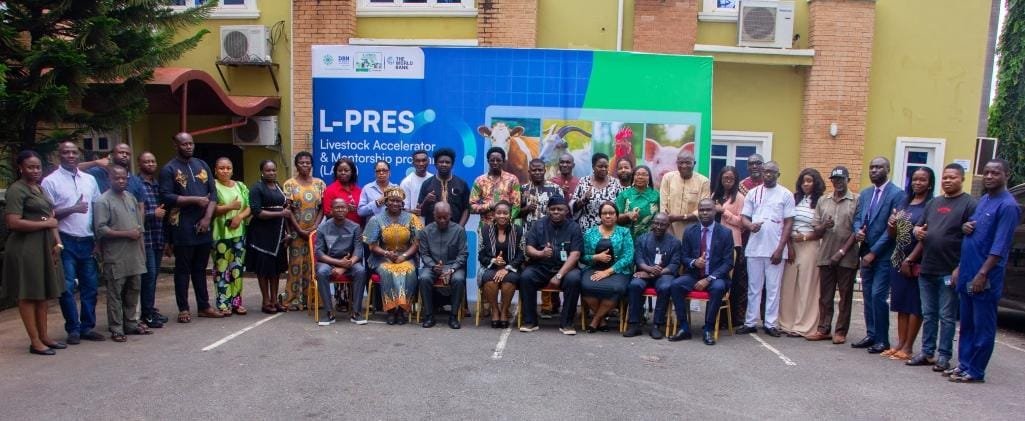
ENUGU — The Development Bank of Nigeria (DBN), in collaboration with the Livestock Productivity and Resilience Support Project (L-PRES), has commenced the second phase of capacity building for selected livestock farmers and entrepreneurs from Enugu and Ebonyi states.
The five-day Livestock Accelerator and Mentorship Programme (LAMP), which began in Enugu on Monday, is designed to strengthen participants’ capacity in business management, financial literacy, productivity, documentation and access to credit.
The programme is part of the second phase of L-PRES capacity building and is aimed at developing sustainable and commercially viable livestock businesses across the South-East.
Speaking at the opening of the programme in Enugu, Dr Adeniyi Adedoyin, Director and Project Coordinator, Federal Ministry of Livestock Development, said LAMP evolved from the Nigerian Livestock Growth and Acceleration Strategy developed by the ministry.
Adedoyin said the strategy was designed to build a sustainable, inclusive and globally competitive livestock sector in Nigeria.
He said access to finance and credit was one of the 10 pillars of the strategy, stressing that developing a critical mass of micro, small and medium enterprises (MSMEs) in the livestock sector required access to affordable credit.
The director commended DBN for successfully implementing the first phase of the capacity-building programme across the six geopolitical zones.
He said the first phase provided livestock entrepreneurs with foundational knowledge and skills, including the documentation required to access credit from financial institutions.
According to him, LAMP was designed as a continuation of the first phase to deepen participants’ understanding of how to operate profitable and sustainable businesses.
Adedoyin said financing available under the programme was subsidised at about 16 per cent, compared with commercial lending rates of about 30 per cent.
Mr Fortune Granville, Capacity Building Manager, DBN, said the programme was funded by the World Bank through the Federal Ministry of Livestock Development under L-PRES.
Granville said DBN was implementing Component 2.2 of the project, which focused on capacity building and access to finance.
He said DBN was providing training and technical expertise, while participating financial institutions would provide loans to qualified MSMEs.
According to him, many small business owners lacked critical documents, licences and statutory filings required by financial institutions to access credit.
Granville said at least 60 livestock entrepreneurs participated in the first training conducted in January for the South-East zone, while 20 top-performing participants were selected for the current accelerator and mentorship programme.
He said the selected beneficiaries would undergo five days of intensive training, followed by six months of mentorship and hand-holding by experts.
Mrs Heather Akanni, National Value Chain Consultant, L-PRES, said the initiative would provide additional mentorship and support to enable beneficiaries to apply the knowledge acquired to expand their businesses across different livestock value chains.
Akanni said access to finance remained a major challenge in the livestock sector.
She said participating financial institutions were being encouraged to consider businesses across the wider livestock value chain, including processing, packaging and marketing, rather than focusing solely on production.
She also urged livestock businesses to embrace insurance to protect their investments and improve their eligibility for financing.
Dr Ifeyinwa Nnajieze, Enugu State Project Coordinator, L-PRES, said Enugu hosted the first L-PRES Small and Medium Enterprise/Participating Financial Institution (SME-PFI) regional training for the South-East from Jan. 26 to Jan. 30, 2026.
Nnajieze said the training involved selected farmers in mandatory BizAid online training, practical sessions and expository teaching, while some livestock farmers received grants after emerging first to third in a test conducted by DBN.
She said Enugu was selected as a pilot state for the programme and that the outcome had been encouraging.
According to her, Enugu was again selected to host the South-East geopolitical zone for the L-PRES Livestock Accelerator and Mentorship Programme because of the state’s strategic role in Nigeria’s livestock sector and the support of Gov. Peter Mbah’s administration for livestock development.
Nnajieze listed some of the state’s livestock development initiatives to include the ongoing construction of an Integrated Livestock Development Centre at Ubahu-Amankanu in Nkanu East Local Government Area.
She said the facility would comprise an irrigation plant, grazing land, feedlot and meat processing facilities.
The ongoing centre is part of the state’s wider L-PRES livestock development infrastructure, with the Federal Ministry of Livestock Development previously describing the Ubahu-Amankanu facility as a major integrated livestock development project.
One of the beneficiaries, Mr Christopher Okeke, who received a N500,000 grant during the first phase of the programme, said the intervention enabled him to return to pig farming after financial difficulties forced him to suspend the business temporarily.
Okeke said he used the grant to purchase piglets and restructure his business.
![US publishes names, photos of 24 Nigerians to be deported [FULL LIST]](https://frontlineafrica.com.ng/wp-content/uploads/2026/10/united-states-flag.jpg)