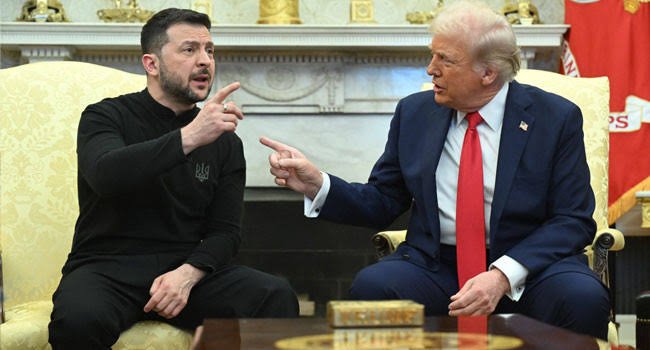
United States President Donald Trump has said it is time for Ukraine to elect a new president, escalating his criticism of Ukrainian President Volodymyr Zelensky following a dispute over a US agreement to ease sanctions on Russian diesel exports.
Trump made the remarks on Saturday while leaving the White House, accusing Zelensky of creating problems for the world by continuing to authorise attacks on Russian oil refineries.
“He’d better damn well stop,” Trump said, before suggesting that Ukraine should “get a new leader who can make a deal”.
The comments followed Zelensky’s criticism of an agreement allowing Russia to resume diesel exports to the United States, which the Ukrainian leader described as a gift to Russian President Vladimir Putin.
Zelensky warned that the arrangement would provide Moscow with additional revenue to purchase military equipment and sustain its war against Ukraine.
Trump, however, defended his position, saying the United States had told Ukraine it could continue fighting Russia but should not target its refineries.
“We said, ‘you can do whatever you want to Russia, don’t hit the refineries’, because that’s a world problem that’s caused,” the US president said.
“He could have made many deals and for some reason, he never does,” Trump added, referring to Zelensky.
Trump confirmed on Friday that an agreement had been reached with Moscow to suspend sanctions on Russian diesel exports until April 7.
Under the arrangement, Russia would initially release 300,000 tonnes of diesel into the American and global markets, followed by another 500,000 tonnes in November.
Trump said a further one million tonnes would be supplied, followed by another three million tonnes “within a short period of time”.
He, however, noted that the final delivery would depend on the condition of Russia’s diesel refineries.
Zelensky condemned the agreement, warning that it would enable Russia to raise additional funds to acquire military equipment and continue its invasion of Ukraine.
He also accused Moscow of interpreting the deal as permission to intensify its attacks.
According to Zelensky, Russia appeared to understand the agreement “to mean they can keep fighting, to mean they keep dropping bombs on cities”.
His comments followed deadly Russian strikes on Zaporizhzhia, which reportedly killed at least 15 people.
The Ukrainian president held discussions with several international allies on Saturday, calling for “real decisions to protect lives in Ukraine” and safeguard European security.
The European Union’s foreign affairs chief, Kaja Kallas, also criticised the US-Russia arrangement, warning that suspending sanctions would increase Moscow’s resources for continuing the war.
“This is not the time to ease pressure on Russia, and Europe won’t,” Kallas said.
She added that European foreign ministers intended to approve the biggest package of sanctions against Russia since the beginning of its full-scale invasion of Ukraine on Monday.
The agreement is the latest effort by the Trump administration to reduce fuel prices in the United States ahead of the country’s midterm elections.
Fuel costs have risen sharply following the war involving Iran, which began in February, putting additional pressure on American consumers and contributing to broader inflation concerns.
According to the American Automobile Association, the average price of diesel stood at $6.28 per gallon, compared with $5.94 the previous month and $3.68 a year earlier.
Meanwhile, Russia has experienced two waves of severe fuel shortages over the past 10 months following Ukrainian drone attacks on its oil refineries.
The International Energy Agency estimated that diesel production in Russia had fallen by about 30 per cent.
Trump had previously called for fresh elections in Ukraine last December, arguing that Ukrainian voters should have the opportunity to replace Zelensky.
However, Ukraine has remained under martial law since Russia launched its full-scale invasion in 2022, resulting in the suspension of elections.
The latest dispute comes amid intensified Russian and Ukrainian attacks on energy infrastructure, transportation facilities and major logistics hubs.
Zelensky’s administration has maintained that easing economic pressure on Moscow would undermine efforts to end the war, while the Trump administration has defended the diesel agreement as part of its effort to reduce fuel prices in the United States.
![US publishes names, photos of 24 Nigerians to be deported [FULL LIST]](https://frontlineafrica.com.ng/wp-content/uploads/2026/10/united-states-flag.jpg)