|By Prosper Okoye
ABUJA — The Child Protection Network (CPN) has urged all parties and authorities involved in the adoption and custody dispute over a child identified as Jada to place her safety, dignity and best interests above the legal battle between the adults.
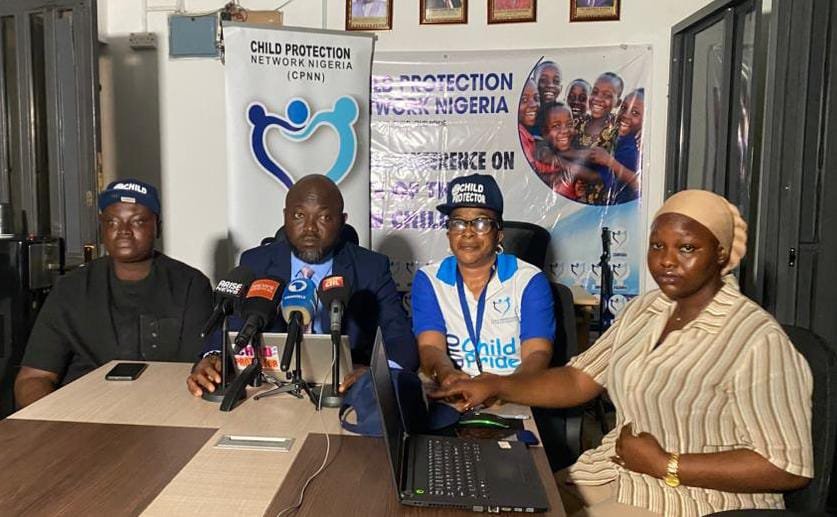
The National Coordinator of CPN, Mr Olakunle Sanni, made the call on Thursday in Abuja at a press briefing on the state of the Nigerian child.
Sanni said the organisation was monitoring the case involving lawyer Timipre Wolo and U.S.-based pastor, Mr Godstime Pender, and had concerns over issues raised in documents relating to the adoption process.
“Our concern is the child,” Sanni said.
“The legal battle is between adults; the child must not become the battlefield.”
He said documents in the public domain had raised questions about the residence of the prospective adoptive parents, documentation and compliance with provisions of the Abia State Child Rights Law.
Sanni, however, stressed that CPN would not prejudge the case or take sides, saying its primary concern was the welfare of the child.
According to him, adoption is a legitimate child-protection mechanism when conducted lawfully and in the best interests of a child, but warned against its alleged misuse as a channel for trafficking, exploitation or illegal transfer of children.
The organisation also questioned aspects of the Jada adoption case, including whether the circumstances surrounding the residence and physical care of the child were consistent with applicable adoption requirements.
According to court records, Godstime and Joyce Pender obtained an adoption order in respect of Jada from a Family Court in Abia State on July 14, 2020.
The FCT High Court ruling of May 10, 2024, said the Penders’ case was that they alternated their residence between the United States and Abia State and that Jada was placed with Wolo in Abuja while she was in transit to join them abroad, following COVID-19 travel restrictions.
The ruling also recorded Wolo’s contrary position that the Penders did not reside in Abia State and that Jada had been in her custody in Abuja from March 2020.
The FCT High Court, presided over by Justice H. Mu’azu, held that it lacked jurisdiction to review, set aside or sit on appeal over an adoption order made by a competent court in Abia State.
The court consequently struck out the suit and ordered that custody of the child be granted to the Abia State Government, with the transfer to be handled by the Social Welfare Offices of the FCT and Abia State Governments.
Sanni said the prolonged separation of the child from the adoptive parents, as reflected in information available to the organisation, raised further child-welfare concerns.
“Information in the public domain also reveals that the child and the adopters never lived together for many years after the completion of adoption,” CPN said.
“This long separation can be likened to child abandonment, and such definitely is not in the child’s best interest.”
He advised Nigerians living abroad who intend to adopt children to be prepared to live with and personally care for them, rather than leaving them for extended periods with relatives, friends or temporary caregivers.
“If you ever have to adopt a child, you must be willing and ready to live together with the child before and after the adoption process is completed rather than procure friends or relatives to undertake an adoption by proxy,” the organisation said.
CPN also appealed to the parties, the media and relevant authorities to shield Jada from publicity, social-media disputes, emotional pressure and unnecessary exposure.
It urged the court and child-protection authorities to ensure that every decision concerning the matter was guided by the child’s safety, stability, dignity and best interests.
Beyond the Jada case, Sanni disclosed that the CPN Help Centre had received at least 36 cases of child abuse within a few months.
He said the cases involved physical abuse, neglect, child trafficking, sexual abuse and illegal adoption.
Sanni said the cases reflected wider challenges confronting Nigerian children, including abduction, trafficking, homelessness, hunger, poverty, exclusion from education and inadequate healthcare.
He called for stronger enforcement of child-protection laws, faster investigation and prosecution of offenders, and improved access to medical, legal and psychosocial support for survivors.
On child trafficking, Sanni urged the government to strengthen border protection, family tracing, documentation, public awareness and reintegration programmes, while creating safer alternatives for vulnerable families.
He also called for stronger measures against child abduction, particularly from schools and conflict-affected communities, including improved intelligence gathering, early-warning systems, community participation, rapid response and better security around vulnerable schools.
“A school should be a place of learning and protection, not a place where children fear being kidnapped,” he said.
Sanni further urged the government to improve education, healthcare and social-support systems for vulnerable children, including street-connected children and Almajiri.
He said such children should be treated as vulnerable members of society requiring protection and rehabilitation rather than as criminals.
“These are children—not criminals,” he said.
Sanni urged government, parents, communities, traditional and religious institutions, schools, security agencies, civil society organisations, the private sector and the media to work collectively to protect Nigerian children.
“The Nigerian child must not be an afterthought in Nigeria’s development agenda. Protecting the Nigerian child is not charity. It is a national responsibility,” he said.

![US publishes names, photos of 24 Nigerians to be deported [FULL LIST]](https://frontlineafrica.com.ng/wp-content/uploads/2026/10/united-states-flag.jpg)