
By Christian Nwangene
Two Nigerian researchers, Engr. Atemoagbo Oyarekhua Precious and Prof. Otache Martin Yusuf, have secured a Nigerian patent for a technology designed to improve flood-risk prediction in metropolitan areas.
The invention, titled “System and Method for Adaptive Metropolitan Flood Risk Prediction Using Hybrid Uncertainty Modeling and Evolutionary Optimization”, combines environmental data and computational techniques to assess locations that may be vulnerable to flooding.
The technology could have implications for urban planning, infrastructure development and disaster preparedness.
The invention was registered under Nigerian business method patent Certificate of Registration No. 001154, with reference number NG/PT/NC/O/2026/22162.
The registration is dated 1 April 2026, while the patent was sealed on 27 April 2026.
Six academics at the Federal University of Technology, Minna (FUT Minna), have commended the development, describing it as an example of research aimed at addressing engineering and environmental challenges.
They also stressed the need for further research, independent evaluation and practical testing to determine how well the framework performs under different environmental conditions.
How the Technology Works
The patented framework integrates satellite-based precipitation information, ground-based rainfall measurements and geospatial data to support metropolitan flood-risk assessment.
It also considers factors including elevation, drainage density, land use, proximity to water bodies and indicators of vulnerability.
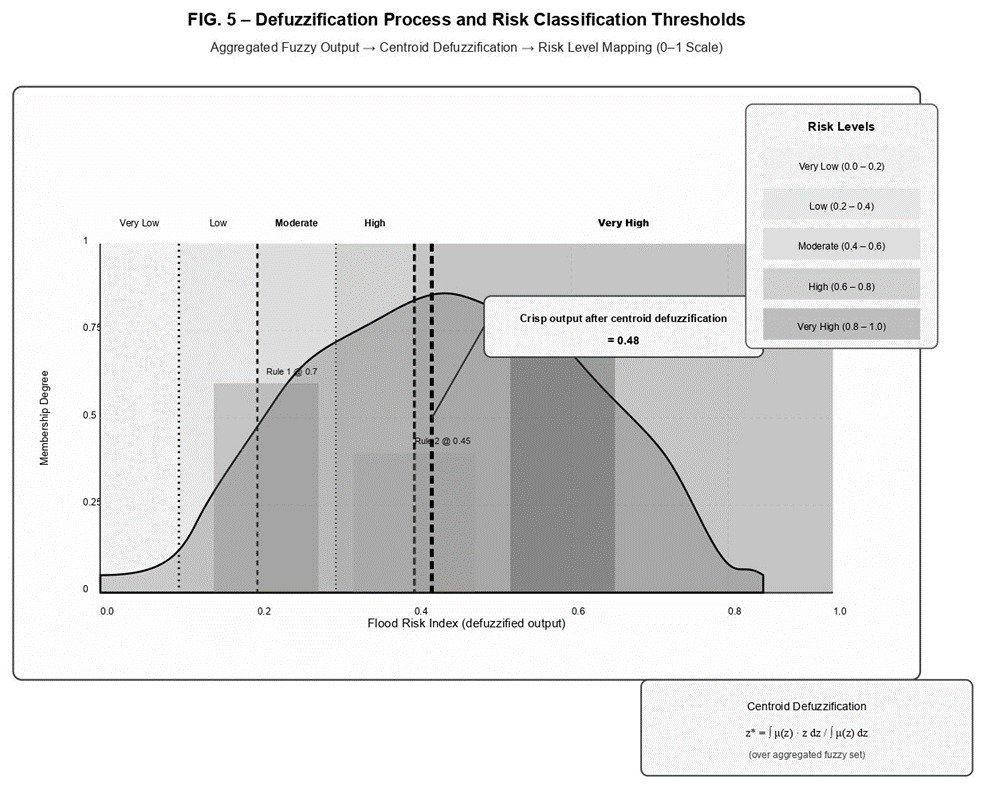
The system uses genetic algorithm optimisation and a Mamdani-type fuzzy inference system to process the information and support the assessment of flood risk.
The approach is designed to bring multiple environmental indicators together while accounting for uncertainty in the available data.
Flood-risk assessment can be complicated by variations in rainfall, terrain, drainage infrastructure and land-use patterns. These factors can interact differently across urban areas, making it difficult to assess the likelihood and potential impact of flooding using a single indicator.
By incorporating several variables into one computational framework, the researchers aim to provide a structured approach to identifying and assessing potentially flood-prone locations.
Such an approach could be relevant to engineers, urban planners, environmental researchers and disaster-management authorities seeking to understand flood exposure and inform planning decisions.
Academics Commend Research Initiative
Prof. Olalekan David Adeniyi, Head of the Department of Chemical Engineering at FUT Minna, said the invention demonstrated the value of interdisciplinary research in addressing complex engineering problems.
“This invention demonstrates the value of interdisciplinary research in addressing complex engineering challenges. Innovative computational approaches such as this could contribute to improved flood-risk assessment and support more informed infrastructure and environmental planning. It is encouraging to see Nigerian researchers developing solutions to problems of national and global importance,” he said.
Prof. Eyitayo A. Afolabi, Head of the Department of Petroleum and Gas Engineering at FUT Minna, said the patent highlighted the importance of research, innovation and the practical application of engineering knowledge.
“The patent highlights the importance of research, innovation and the practical application of engineering knowledge. Developing approaches that can help address data limitations in flood-risk prediction is a valuable research direction. I hope this achievement will encourage more researchers and young engineers to pursue innovative solutions to pressing societal challenges,” he said.
The Deputy Dean of the School of Infrastructure, Process Engineering and Technology (SIPET) at FUT Minna described the development as a promising contribution to environmental risk assessment and disaster preparedness.
“This achievement reflects the importance of research-driven innovation in engineering and technology. The development of a patented framework for adaptive flood-risk prediction is a promising contribution to environmental risk assessment and disaster preparedness. Such work reinforces the need to support research with practical applications that can benefit communities and strengthen infrastructure resilience,” the Deputy Dean said.
Prof. Chiemela Enyinnaya Chinma, Director of the Directorate of Research, Innovation and Development (DRID) at FUT Minna, said the development highlighted the importance of intellectual property protection and the need to translate research into practical applications.
“Research and innovation are essential to the development of solutions to emerging societal challenges. Securing a patent for an engineering innovation addressing flood-risk prediction is a commendable milestone. It also highlights the importance of protecting intellectual property, strengthening research collaboration and creating pathways through which university research can be further developed, validated and translated into practical applications,” he said.
Prof. John Jiya Musa, a professor at FUT Minna, said research aimed at improving the identification and assessment of flood-prone areas was important because of the effects of flooding on communities, infrastructure and urban development.
“Flooding poses serious challenges to communities, infrastructure and sustainable urban development. Research that seeks to improve the identification and assessment of flood-prone areas is therefore important. This patented innovation is a positive step towards strengthening the tools available to researchers and decision-makers, although further testing in different locations will be important in establishing its practical performance,” he said.
Prof. Solomon Musa Dauda, also a professor at FUT Minna, said the achievement reflected the capacity of Nigerian academics to contribute to engineering innovation and develop solutions relevant to local challenges.
“The achievement underscores the capacity of Nigerian academics to contribute to engineering innovation and the development of locally relevant solutions. Protecting such intellectual property is an important milestone, while continued research, collaboration and independent evaluation can help determine how the technology may be applied to flood-risk management and urban planning,” he said.
The academics comments point to two related issues; the importance of encouraging research that addresses practical problems and the need to establish whether new technologies can deliver measurable benefits.
Research Collaboration and Professional Background
Atemoagbo Oyarekhua Precious and Otache Martin Yusuf are the co-inventors of the flood-prediction framework.
Their work brings computational modelling and environmental information together to address a problem with implications for urban development, infrastructure management and public safety.
Flooding can damage buildings, disrupt transport networks, overwhelm drainage systems and threaten livelihoods. Its effects can be particularly severe in urban areas where population growth, changes in land use, inadequate drainage and rainfall patterns interact.
Research into flood-risk prediction seeks to improve understanding of where flooding may occur and which locations or infrastructure may be most exposed.
The patent represents an intellectual property milestone for the researchers.
Research Experience in New Zealand
Atemoagbo Oyarekhua Precious is a registered engineer with the Council for the Regulation of Engineering in Nigeria (COREN).
He graduated among the top one per cent of his cohort at FUT Minna and is now a doctoral researcher and research assistant at the University of Auckland in New Zealand.
His research activities in New Zealand include flood-risk calculations and infrastructure vulnerability assessments for Wellington City Council.
Those activities are separate from the Nigerian patent, although they are broadly related to flood-risk assessment and infrastructure resilience.
The experience provides additional context for his professional interest in engineering approaches to environmental challenges.
Otache Martin Yusuf is a co-inventor of the flood-prediction framework alongside Atemoagbo Oyarekhua Precious.
Inv. Dr. Sadeeq Mohammed has also commended the researchers’ innovation.
Potential Applications and Need for Validation
Flood-risk information can help authorities and planners identify potentially vulnerable locations and inform decisions about land use, infrastructure development and disaster preparedness.
The patented framework seeks to contribute to this process by combining rainfall information, geographical characteristics and computational techniques in a single analytical approach.
Nigerian Engineering Research and Innovation
The patent adds to the body of engineering research undertaken by Nigerian researchers to address environmental and infrastructure challenges.
The reactions from FUT Minna academics also highlight the importance of protecting intellectual property, supporting collaboration between researchers and creating opportunities for research findings to undergo further technical evaluation.
Turning an engineering invention into a practical tool can require additional testing, access to reliable data, collaboration with relevant institutions and assessment of its suitability for real-world conditions.
For flood-risk prediction, such work would be particularly important because decisions based on inaccurate assessments could have consequences for infrastructure planning, emergency preparedness and communities exposed to flooding.
The researchers’ patent establishes a formal intellectual property milestone for the framework.