Local governments have been urged to move beyond infrastructure provision and adopt evidence-based strategies that tackle the structural causes of poverty through education, employment, social protection and sustainable economic opportunities.
The call comes amid persistent poverty across Nigeria, where millions of households struggle with inadequate income, food insecurity, poor sanitation and limited access to essential services.
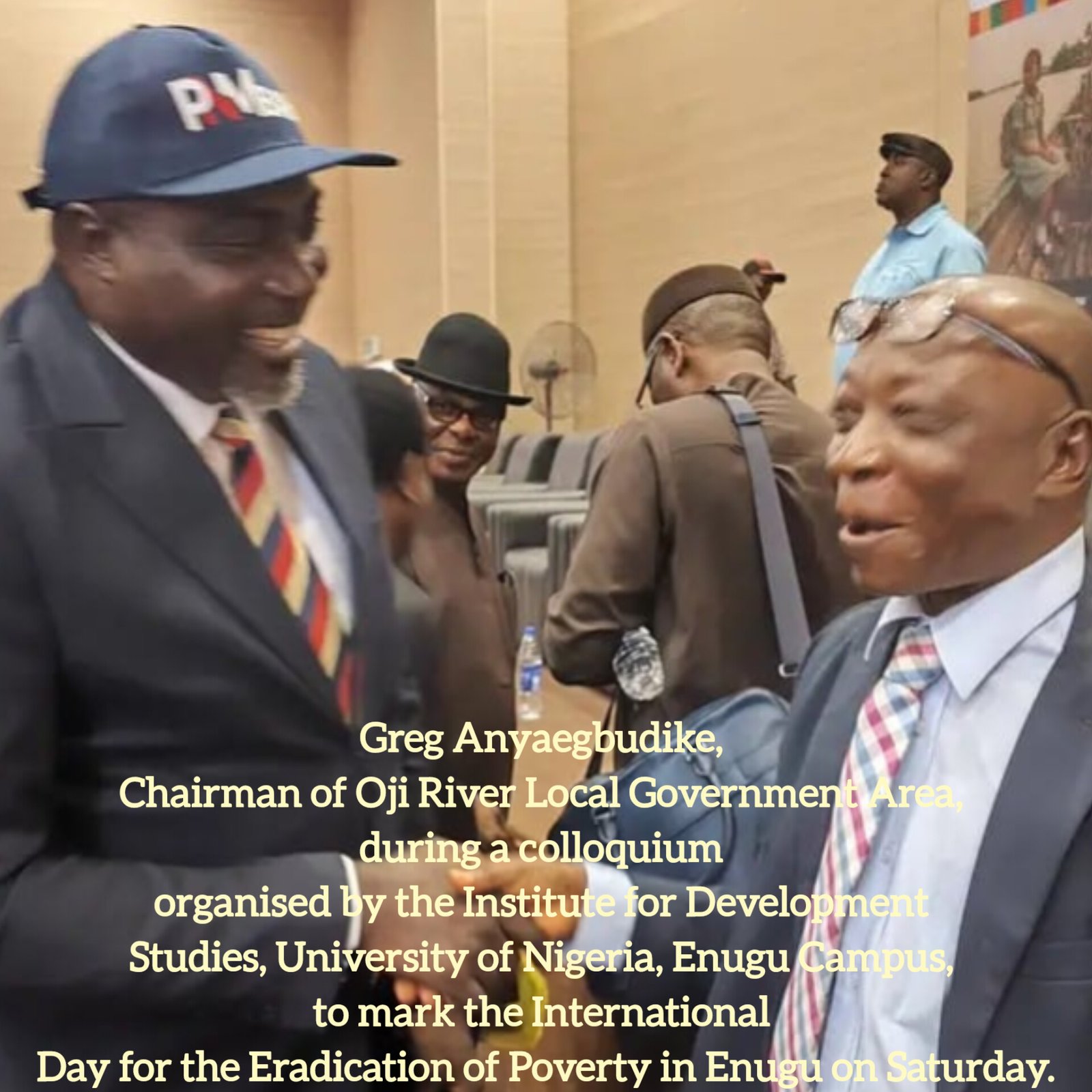
The issues featured prominently at a colloquium organised by the Institute for Development Studies (IDS), University of Nigeria, Enugu Campus, on Saturday to commemorate the International Day for the Eradication of Poverty.
The event, themed “Reimagining Local Governance for Poverty Reduction,” examined the role of grassroots governance in addressing deprivation and improving living conditions. Dr Joe Abah, Country Director of DAI Global, presented the lead paper, while the Chairman of Oji River Local Government Area, Greg Anyaegbudike, participated as a panellist.
Nigeria’s poverty burden
The National Bureau of Statistics’ 2022 Multidimensional Poverty Index survey estimated that 133 million Nigerians, representing 63 per cent of the population at the time, were living in multidimensional poverty.
The survey, conducted between November 2021 and February 2022, measured deprivation beyond income, including education, health, living standards and access to basic services. It found that multidimensional poverty affected 72 per cent of rural residents, compared with 42 per cent of urban residents.
More recent World Bank estimates point to the continuing scale of the challenge. Its Nigeria country profile estimates that 69.6 per cent of Nigerians lived below the lower-middle-income poverty threshold of $4.20 a day in 2025, while 50.8 per cent, or about 123 million people, lived in extreme poverty. The bank attributed the persistent burden partly to high inflation and weak growth in real incomes.
The figures use different poverty thresholds and methodologies and should not be interpreted as a direct year-on-year comparison with the 2022 Nigerian survey.
Nevertheless, they highlight a central policy challenge: economic growth and government spending do not automatically translate into improved living standards for vulnerable households.
Education as a long-term poverty strategy
At the colloquium, Anyaegbudike identified education as an important instrument for breaking intergenerational poverty, citing the Smart Green Schools initiative of the Enugu State Government.
He commended Governor Peter Mbah’s administration for establishing the schools across the state’s 260 electoral wards and said Oji River had 20 schools serving 20 political wards.
“Education is the most effective weapon against poverty, and these Smart Green Schools are the surest route to ending poverty at the grassroots,” he said.
Anyaegbudike added that technology-driven education could equip children with skills relevant to future employment and economic opportunities.
“These 21st-century, technology-driven and innovative Smart Green Schools expose children to skills and technology, preparing them for the world they will live and work in,” he said.
Education can contribute to poverty reduction by improving literacy, technical competence and access to better-paying employment. However, the construction of schools alone does not establish that these outcomes have been achieved.
The impact depends on the quality of teaching, availability of qualified teachers, access to learning materials, pupils’ attendance and completion rates, and whether graduates acquire skills that employers need.
For the benefits to extend to the poorest households, governments must also address barriers such as school-related costs, inadequate nutrition, transport difficulties and the need for children to contribute to household income.
The broader policy question is how to connect investments in education to vocational training, apprenticeships, digital skills, local industries and job creation.
Scholarships and enterprise support
Anyaegbudike also outlined education and economic empowerment initiatives undertaken by his administration in Oji River.
He said the council had awarded scholarships to 122 indigenes studying at two institutions: 49 at the Enugu State College of Health Technology, Oji River, and 73 at the Federal Cooperative College, Oji River.
According to him, arrangements for the second edition of the scholarship programme at both institutions were ongoing.
“I believe that education remains the most powerful tool for eradicating poverty,” he said.
The chairman also disclosed that the council provided monthly business grants of ₦100,000 to 20 women selected across its electoral wards, adding that more than 500 women had benefited from the programme.
He said the administration intended to deepen its human-capital development agenda during its second term.
“We will also invest in education, skills acquisition and enterprise so that our people can lift themselves out of poverty sustainably,” he said.
These interventions address two important dimensions of poverty: the cost of accessing education and the shortage of capital available to small-business owners.
However, their longer-term effectiveness depends on whether scholarship recipients complete their studies and secure employment, and whether business beneficiaries can sustain their enterprises, increase earnings and employ additional workers.
For the business-grant scheme, useful performance indicators would include the number of active businesses after 12 and 24 months, changes in beneficiaries’ income, jobs created and the proportion of businesses that remain operational.
Similarly, scholarship programmes should track graduation rates, professional certification and employment outcomes.
Publishing such results would help residents assess the programmes’ impact and enable the council to improve their design.
What states and local governments must do
Nigeria’s poverty challenge requires coordinated action across all three tiers of government, with local authorities playing a particularly important role because of their proximity to communities.
Existing approaches include conditional cash transfers, school feeding, social registers for identifying vulnerable households, skills training and enterprise support.
The National Social Investment Programme Agency lists cash transfers, school feeding, enterprise and empowerment initiatives among the federal government’s social-protection interventions. These programmes are intended to address immediate household needs while supporting education, nutrition and economic participation.
Evidence also suggests that targeted assistance can improve household welfare. A study published in the Journal of Social Policy found that beneficiaries of Nigeria’s cash-transfer programme reported better food security and dietary diversity than comparable non-beneficiaries. Such findings demonstrate the potential of social protection to reduce immediate hardship, although individual programme results cannot automatically be generalised to every intervention or community.
For state and local governments, the challenge is to combine these approaches rather than rely on isolated projects.
Education programmes should be linked to skills development and employment opportunities. Agricultural interventions should improve farmers’ productivity and market access. Business grants should be accompanied by financial literacy, mentoring and access to markets. Social protection should reach eligible households transparently and reliably.
Local governments can also use community-level data to identify households facing the greatest deprivation and direct resources towards areas with poor school attendance, inadequate sanitation, food insecurity and limited access to healthcare.
Equally important is public accountability. Budgets, beneficiary-selection criteria, implementation reports and independently verifiable outcomes should be available to residents.
Reimagining local governance
The colloquium’s theme raises a fundamental question: how can local governments move from administering projects to producing measurable improvements in people’s lives?
The answer requires more than announcing the number of schools built, scholarships awarded or grants distributed. Governments must demonstrate whether these investments are improving learning, increasing household incomes, creating employment and reducing deprivation.
For Oji River, the next step would be to establish clear baselines and publish periodic results from its scholarship and women’s enterprise programmes. For Enugu State, comparable data on school participation, learning outcomes, skills acquisition and employment would help establish whether education investments are translating into improved economic prospects.
At the national level, regular and methodologically comparable poverty surveys remain essential to determine whether living conditions are improving and which policies are producing the strongest results.
Anyaegbudike commended the Institute for Development Studies for organising the colloquium and selecting a theme he described as relevant to grassroots development.
The International Day for the Eradication of Poverty is observed annually on October 17. Its significance extends beyond public awareness: it provides an opportunity for governments, researchers and communities to examine the causes of deprivation and assess whether their policies are delivering meaningful change.
Ultimately, the test of effective local governance is not simply how much government spends, but whether that spending enables people to escape poverty sustainably.