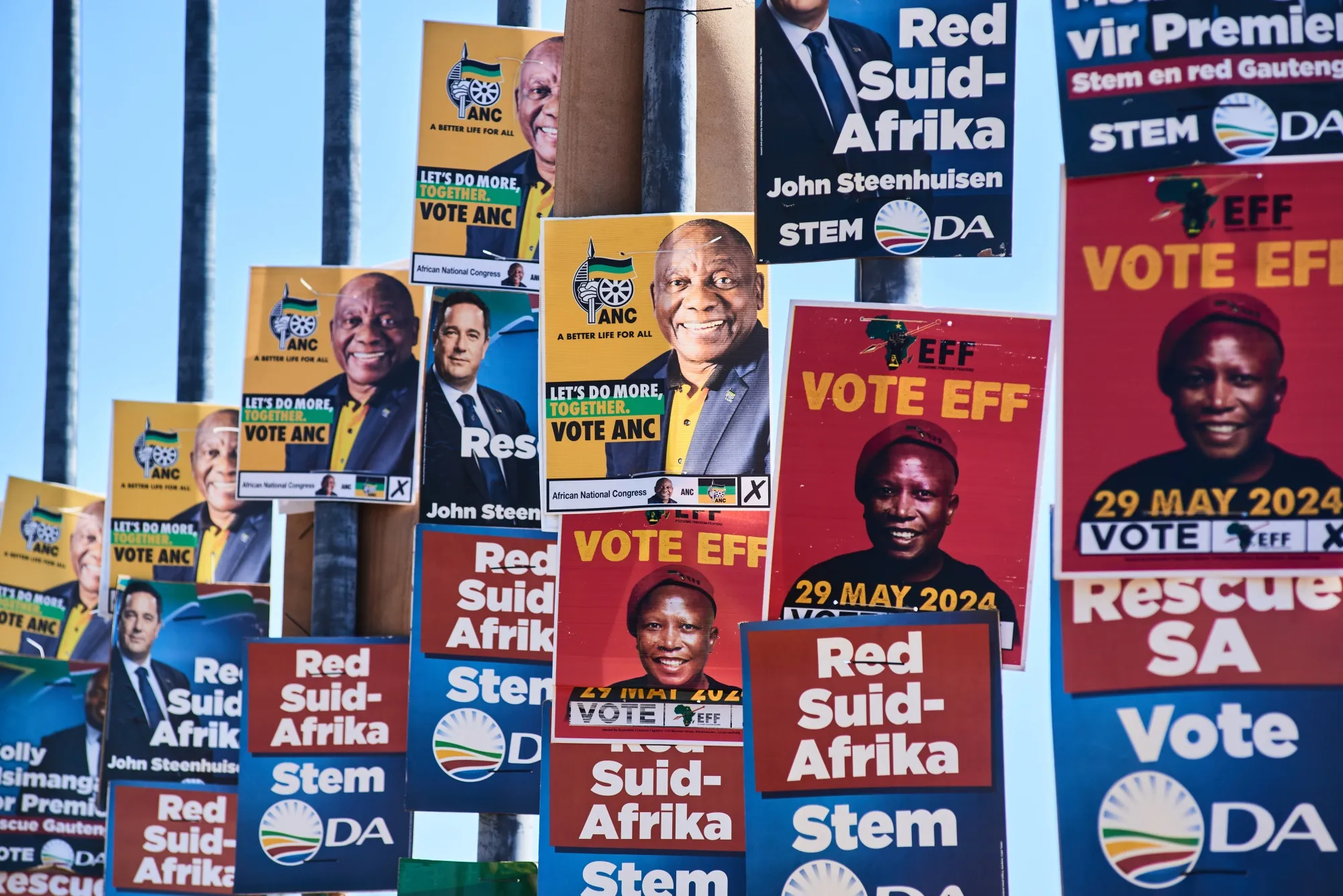
South Africans are voting in closely watched local government elections, with major political parties contesting control of key cities amid growing public frustration over poor service delivery, deteriorating infrastructure, unemployment and persistent inequality.
The elections, regarded as an important test of the country’s political mood ahead of the 2029 general elections, are taking place against the backdrop of declining support for the ruling African National Congress (ANC), which has governed South Africa since the end of apartheid in 1994.
Polling stations opened at 7 a.m. local time and are scheduled to close at 9 p.m., with a record 29.2 million registered voters expected to participate across 23,696 voting stations, according to the Independent Electoral Commission (IEC).
The electorate will choose representatives for eight metropolitan municipalities, 44 district councils and 205 local councils. The elected councillors will subsequently determine the mayors and leadership of the respective municipalities.
The elections follow years of complaints about unreliable water supply, electricity interruptions, deteriorating roads, inadequate sanitation and rising unemployment, issues that have weakened public confidence in local government institutions.
In Johannesburg, the country’s financial centre, the Democratic Alliance (DA) is seeking to capitalise on dissatisfaction with municipal services, including recurring water shortages and electricity problems. The city has experienced five mayors in four years amid unstable coalition arrangements.
The DA has fielded its former leader, Helen Zille, as its candidate for mayor of Johannesburg, with her campaign focusing on infrastructure failures and municipal accountability.
The coastal city of Durban is another major battleground, with former President Jacob Zuma’s uMkhonto weSizwe (MK) Party seeking to consolidate its support following its strong performance in the 2024 national elections.
Addressing supporters at a campaign rally in Durban, Zuma said: “We are going to start by taking back our country here,” according to the AFP news agency.
The campaign in Durban has also been marked by growing anti-immigrant sentiment, with migration emerging as a prominent issue in political messaging.
The ANC, which led the struggle against apartheid and dominated South African politics for three decades, is expected to remain a major political force but faces the prospect of further electoral losses.
The party’s support fell below 50 per cent for the first time in the 2021 municipal elections, when voter turnout stood at 46 per cent. It suffered a further setback in the 2024 national elections, securing about 40 per cent of the vote and losing its parliamentary majority.
The outcome forced the ANC to form a Government of National Unity with the DA and other political parties, ending its long-standing record of governing nationally without a coalition partner.
Recent opinion polls suggest that the ANC could lose further ground in the municipal elections, with some projections placing its national support below 40 per cent. However, the final outcome will depend on voter turnout and the distribution of votes across the country’s municipalities.
The MK Party, which contested its first national election in 2024, secured 14.5 per cent of the vote, emerging as the country’s third-largest political party and drawing significant support from the ANC, particularly in KwaZulu-Natal.
Meanwhile, the DA is seeking to expand its control of municipalities, while smaller parties are positioning themselves to influence coalition negotiations in councils where no single party secures an outright majority.
South African President Cyril Ramaphosa, in his weekly newsletter, acknowledged the impact of municipal failures on public confidence, saying that they had contributed to “declining public trust and confidence in democratic governance.”
The concerns are reflected in the experiences of ordinary voters. Ntombekhaya Makeleni, a resident of Khayelitsha township in Cape Town, told AFP that inadequate sanitation had influenced her decision to participate in the election.
“I will be voting because after voting, things will be fixed,” she said, highlighting the expectations many residents attach to local government elections.
The IEC said approximately 1.43 million of the 2.6 million people approved for special voting had cast their ballots during the two-day exercise preceding the main election.
The commission said the special votes included ballots cast at designated voting stations and through home visits for eligible voters unable to visit polling centres.
The 2026 elections are also being closely monitored because of the growing number of coalition administrations across the country, where political parties must negotiate partnerships to control municipal councils.
The results are expected to shape the political balance in major urban centres and provide an indication of public confidence in the ANC and opposition parties ahead of the next national elections.