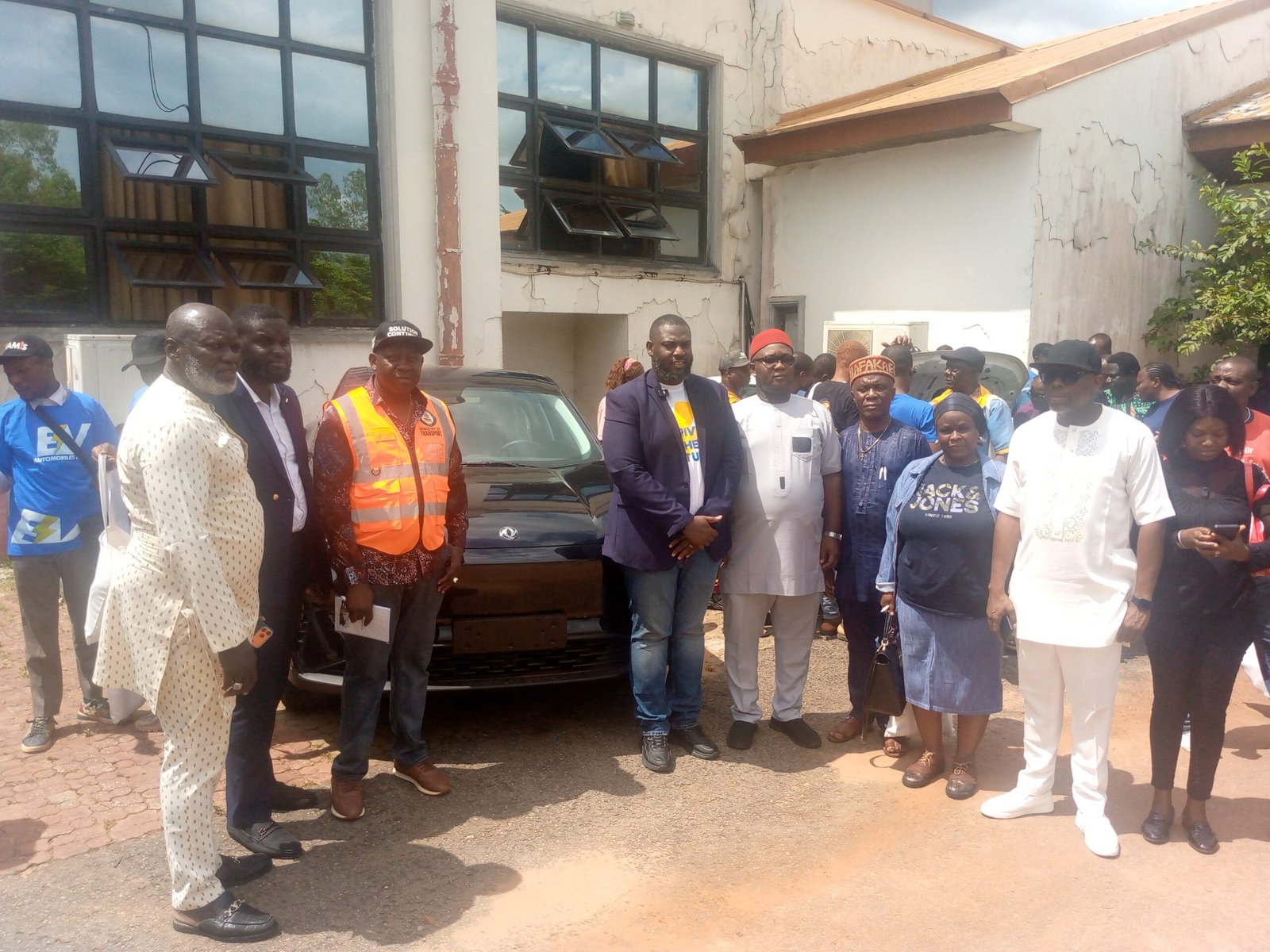
The growing push for electric vehicles in Anambra State has opened a new conversation around jobs, skills and the future of transportation, as a skills acquisition and empowerment workshop on electric vehicles drew a large turnout in Awka.
Speaking at the training, the Anambra State Commissioner for Transport, Hon. Edward Ibuzo, said skill acquisition had become essential in Nigeria, stressing that young people could no longer afford to wait for government employment. He urged participants to use the training as a springboard to create jobs for themselves and others.
“Skill acquisition in Nigeria today is no longer optional but essential,” Ibuzo said. “You no longer need to wait for government to give you jobs. You now have to create jobs by yourselves through trainings as this.”Ibuzo, who is a former member of the Anambra State House of Assembly, recalled that he moved a motion on skill acquisition in the Assembly in 2015.
Drawing from his experience living in Germany, he said the country had demonstrated that vocational skills could provide a viable alternative to the traditional university route. According to him, young people in Germany could proceed into vocational training after secondary school and acquire skills that command respect and provide a livelihood.
He said the same mindset should be encouraged in Nigeria, noting that skilled professionals should not be looked down upon simply because they did not attend university. The commissioner expressed satisfaction with the turnout at the workshop, revealing that organisers had initially expected about 1,000 participants but were surprised by the number that showed up. He was particularly pleased to see women taking part, singling out a female mechanic who travelled from Nnewi to attend the programme.
“I’m proud of all of you for coming to this training and I trust you will not remain the same after the training. I see job creators among all of you,” he told the participants, urging them to remain committed to whatever skills they acquired.
Ibuzo also disclosed that the electric vehicle initiative was not intended to be a one-off exercise, saying he was bringing the training and all the value chain of electric vehicle to stay in Anambra. He said dedicated workshops would be established for electric vehicles as the state gradually prepares for the emerging technology.
The commissioner linked the development to the wider economy, pointing out that transportation remained central to virtually every economic activity. “When the cost of transportation increases, every other commodity increases as well,” he said, adding that electric vehicles could provide opportunities not only for cheaper transportation but also for employment through their maintenance and servicing.
He offered a personal example, saying the cost of fuelling his Hilux V6 was a reminder of the financial burden associated with conventional vehicles. “I drive a Hilux V6 and I know how much it costs me to fill my tank from Awka to Onitsha. In just two to three days, I refill,” he said, noting that an electric vehicle could significantly reduce such recurring fuel expenses.
For some participants, the workshop also provided their first opportunity to see and touch an electric vehicle at close range. Ibuzo said this showed how quickly the technology could change the automobile industry, describing electric vehicles as a development capable of revolutionising the sector.
However, the Anambra State Chairman of the Road Transport Employers Association of Nigeria (RTEAN), Hon. Chukwuka Okonkwo, urged caution alongside the enthusiasm surrounding electric vehicles.
Okonkwo said the transport sector had changed considerably and that operators needed to follow emerging trends, including the global move towards greener transportation. But he said important questions surrounding electric vehicles must be answered before mass adoption.
“Though electric vehicle is good, there are questions about its durability, maintenance and the lifespan of batteries of these vehicles,” he said. He pointed out that the battery was central to the operation of an electric vehicle and warned that buyers could face serious difficulties if adequate maintenance infrastructure was not established.
Okonkwo drew a comparison with the introduction of Compressed Natural Gas (CNG) vehicles, saying the initial rollout was accompanied by concerns over the availability of filling stations. He therefore called on electric vehicle promoters to put the necessary infrastructure in place, particularly maintenance facilities and other support systems, before encouraging people to make the switch.
The training, which began on Thursday, September 19, was scheduled to end on Saturday, September 21.
The highlight of the programme was a test run of the electric vehicle by Commissioner Ibuzo, giving participants an opportunity to witness the technology in operation.
The workshop comes as Anambra’s transport authorities continue to push towards a more technology-driven transport system. Recent plans by the state have also included electric buses and smart transport infrastructure.
![US publishes names, photos of 24 Nigerians to be deported [FULL LIST]](https://frontlineafrica.com.ng/wp-content/uploads/2026/10/united-states-flag.jpg)