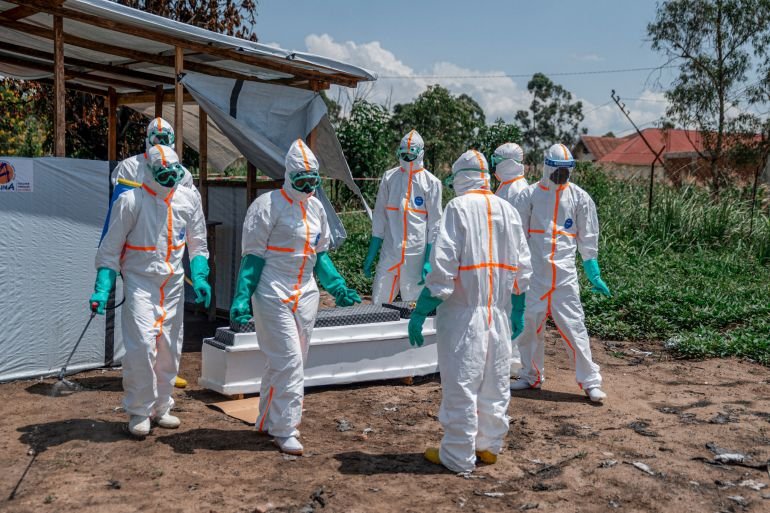
The Ebola outbreak caused by the rare Bundibugyo virus in the Democratic Republic of Congo has intensified, with confirmed cases rising to 4,665 and deaths to 2,184, according to Congolese authorities.
The outbreak has now spread to 54 health zones across six provinces, after authorities confirmed a case in Buta health zone in Bas-Uélé, the sixth province affected. The latest case involved a person who had travelled from neighbouring Haut-Uélé province.
The latest figures, reported by the authorities on Friday, August 14, represent a sharp escalation from the 3,748 confirmed cases and 1,657 deaths recorded by August 1. The pace of transmission has made the outbreak one of the fastest-growing Ebola epidemics recorded.
Rapid geographical spread
The outbreak was initially detected in Mongbwalu Health Zone in Ituri Province in May. It has since spread through Ituri, North Kivu, South Kivu, Haut-Uélé, Tshopo and Bas-Uélé.
According to the latest update, the outbreak recorded its highest weekly figures during epidemiological week 32, with 579 cases and 304 deaths.
Ituri remains the epicentre, accounting for the overwhelming majority of infections and deaths. But the emergence of a confirmed case in Bas-Uélé has heightened concern about the virus moving further through areas connected by population movement, mining activity and trade routes.
The spread has been complicated by armed conflict, population displacement, movement across borders, poor infrastructure, limited healthcare capacity and gaps in contact tracing.
Recent reports indicate that between 60 and 70 per cent of newly detected infections are being found outside previously monitored contacts, making traditional contact-tracing efforts increasingly difficult.
Why this Ebola outbreak is different
The outbreak is caused by Bundibugyo ebolavirus, a distinct Ebola species first identified during an outbreak in Uganda in 2007.
It is not the same strain responsible for the major 2014–2016 West African Ebola epidemic. Previous Bundibugyo outbreaks occurred in Uganda in 2007–2008 and in the Democratic Republic of Congo in 2012. Historical case-fatality rates have ranged from about 30 to 50 per cent.
The current outbreak was officially declared in May after laboratory testing identified the virus in samples from patients in Ituri.
The World Health Organization subsequently classified the outbreak in the DRC and Uganda as a Public Health Emergency of International Concern. Africa CDC also activated a continental-level emergency response.
No licensed vaccine or specific treatment
One of the biggest challenges is that there is currently no licensed vaccine or approved treatment specifically targeting Bundibugyo virus.
Vaccines and therapeutics developed for the Zaire strain of Ebola cannot simply be assumed to protect against Bundibugyo virus because the viruses are biologically different.
WHO has nevertheless identified candidate treatments, including MBP134, Maftivimab and remdesivir, for evaluation through clinical trials. The antiviral obeldesivir has also been identified for investigation as a possible post-exposure preventive treatment.
There is also movement on vaccines. Moderna has begun the first human trial of an experimental Bundibugyo vaccine, mRNA-1469, involving healthy volunteers in Canada.
International response
WHO, Africa CDC, Congolese authorities and other partners are scaling up surveillance, laboratory testing, isolation and treatment facilities, infection prevention and control, safe burials, contact tracing and community engagement.
The WHO and Africa CDC have identified stronger surveillance and closer engagement with affected communities as critical to containing transmission.
However, the response continues to face major operational challenges. Insecurity, strikes and shortages among healthcare workers, inadequate infrastructure, misinformation and population displacement are hampering efforts to identify infections early and trace contacts.
Uganda and France
The outbreak has also crossed national borders.
Uganda recorded imported Bundibugyo cases linked to the DRC, but authorities have not reported continuing local transmission. The latest imported case was discharged on July 16, with the enhanced 42-day monitoring period expected to end on August 27.
France also detected an imported case on June 24 involving a doctor who had returned from the DRC. According to the latest information, no secondary transmission has been recorded in France, with 41 days having passed without another confirmed case by August 14.
Uganda remains at risk of reintroduction because of continued transmission in neighbouring DRC.
What happens next
The immediate challenge for health authorities is to slow transmission before the virus reaches more provinces and crosses into additional countries.
WHO says effective control depends on finding cases quickly, isolating and caring for patients, tracing contacts, protecting healthcare workers, maintaining safe burial practices and building public trust.
The latest expansion into Bas-Uélé underlines the difficulty of containing the outbreak in a region where conflict, population movement and weak health infrastructure can allow infections to move faster than surveillance systems.
For now, the DRC remains at the centre of the emergency, with 4,665 confirmed cases and 2,184 deaths recorded as of August 14, according to Congolese authorities.
![US publishes names, photos of 24 Nigerians to be deported [FULL LIST]](https://frontlineafrica.com.ng/wp-content/uploads/2026/10/united-states-flag.jpg)