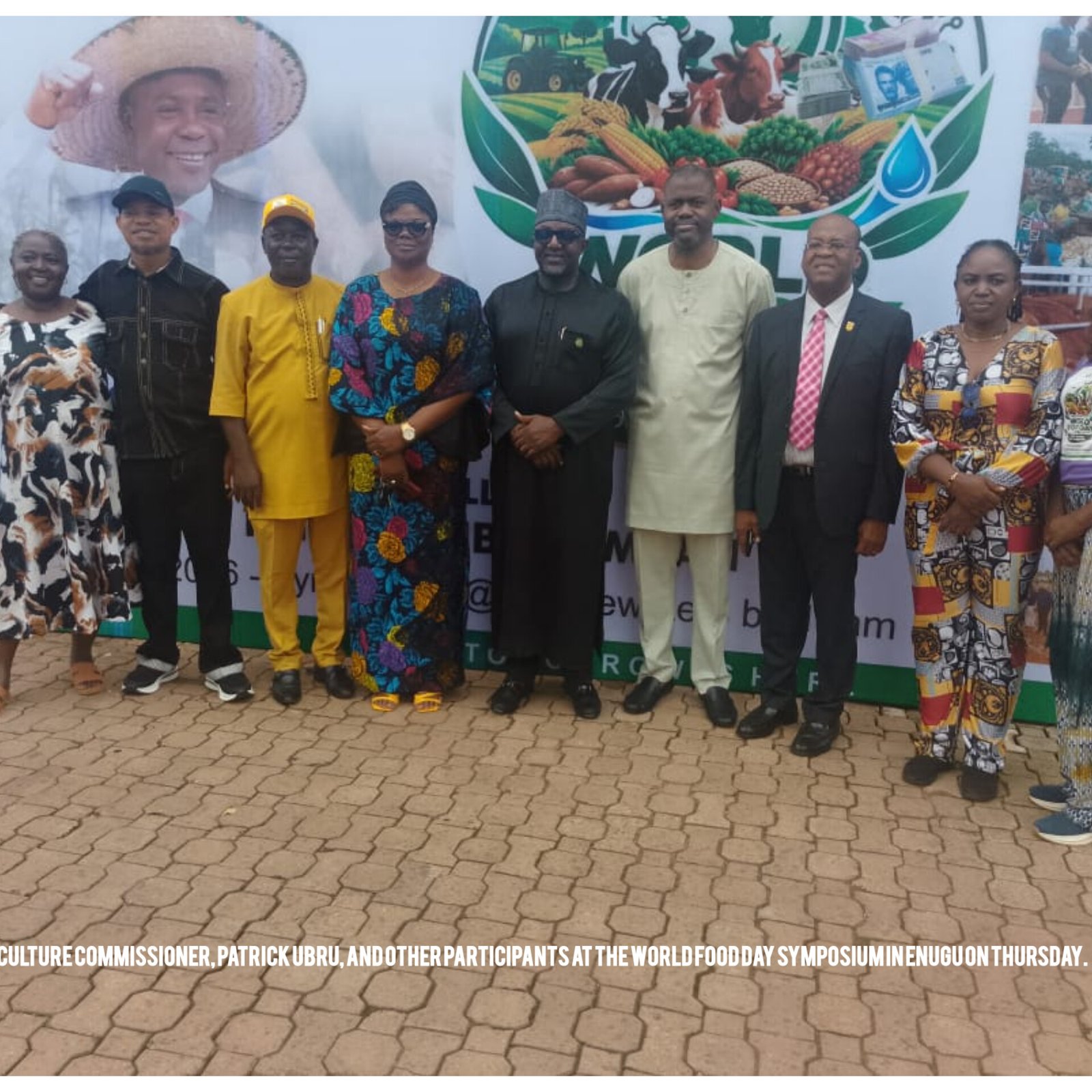
ENUGU — The Enugu State Government says it is intensifying efforts to tackle hunger and boost food production through farm estates across 260 wards, mechanised farming, livestock development and modern agricultural technologies.
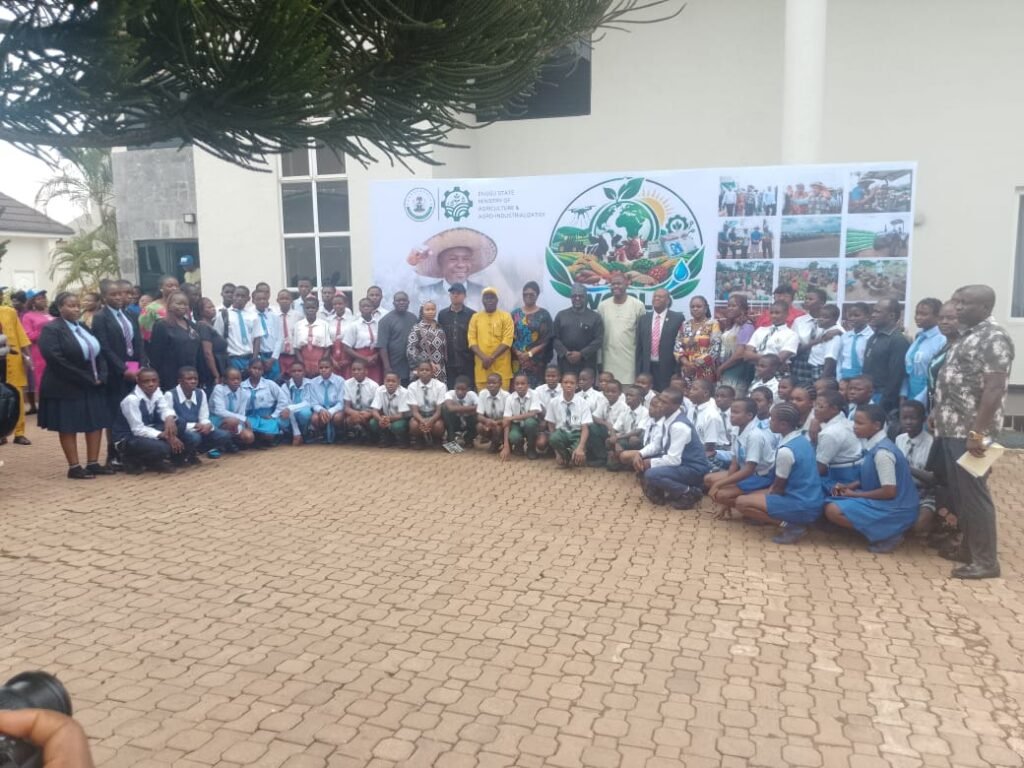
The Commissioner for Agriculture and Agro-Industrialisation, Patrick Nwabueze Ubru, disclosed this at a symposium organised by the ministry at Bridge Waters, Okpara Avenue, Enugu, to commemorate the 2026 World Food Day.
Ubru said the initiatives, introduced under the administration of Gov. Peter Mbah, were designed to reposition agriculture as a commercially viable enterprise, create economic opportunities and strengthen the state’s capacity to meet its food needs.
He said the government was encouraging residents, particularly young people, to embrace agriculture as a business rather than relying on subsistence farming practices.
“Every October 16, World Food Day is celebrated, and we use this opportunity to let the world know the importance of food,” he said.
The commissioner explained that the annual commemoration provided an opportunity to educate residents about the state’s agricultural development initiatives and encourage them to take advantage of emerging opportunities in the sector.
According to him, the introduction of mechanised farming and other modern production methods has made agriculture more attractive and productive, particularly for young people who previously viewed farming as labour-intensive and unprofitable.
Ubru identified the establishment of a tractor assembly plant, investments in livestock development and the provision of modern veterinary services as key components of the state’s agricultural transformation programme.
“There is a departure from what we used to know in 2023 in agriculture to where we are now. Enugu State is producing things we eat, and we are now into green-smart farming, which is attracting the international community to look for our products,” he said.
He attributed the growing interest in the state’s agricultural produce to a demand-driven production approach, which links farming activities to processing opportunities and market requirements.
The commissioner said the government was also developing farm estates across the state’s 260 wards to expand agricultural production, improve food availability and address hunger.
He expressed appreciation to Mbah for supporting the initiatives, adding that the state was working to make agriculture a stronger pillar of economic development.
The symposium attracted farmers, agricultural companies, cooperative societies, researchers, teachers and students from farming communities and smart schools across the state.

AI Can Help Farmers Detect Crop Diseases — Don
In a presentation titled “From Problems to Possibilities: Innovating Today to Nourish Tomorrow”, Prof. Chinenye Anyadike of the University of Nigeria, Nsukka, said agricultural challenges should be regarded as opportunities for innovation.
Anyadike identified water scarcity, crop diseases, food waste and limited market opportunities as major problems confronting farmers.
She explained that the challenges were identified through investigations into farmers’ experiences, stressing that agricultural research should begin with the practical problems encountered in the field.
The professor said artificial intelligence could help farmers make informed decisions by providing information about crop diseases, weather conditions, available markets and prospective buyers.
She encouraged farmers and students to identify problems within their communities and develop innovative solutions capable of improving agricultural productivity.
Anyadike also cautioned researchers against developing solutions in isolation, emphasising the importance of involving farmers and other stakeholders in identifying challenges and designing practical interventions.
She highlighted the potential of biodigesters to convert livestock waste into cooking gas while producing organic manure that could improve soil fertility.
According to her, such technologies could reduce agricultural waste, provide alternative energy sources and promote sustainable farming practices.
Enugu Establishes Model Veterinary Hospital — Iloh
Also speaking, Dr Chidibere Iloh of the Veterinary Services Department of the Ministry of Agriculture and Agro-Industrialisation said the Mbah administration had established the L-PRES Model Veterinary Hospital at Akwuke, Enugu.
Iloh said the facility was equipped with modern infrastructure to support livestock research, animal treatment and innovation in veterinary services.
He explained that the department’s responsibility included identifying challenges preventing farmers from meeting their production targets, analysing the problems and developing appropriate solutions.
Iloh commended Ubru for initiatives aimed at improving agricultural development, noting that efficient veterinary services were important for livestock health and productivity.
Enugu Among Top 10 Agricultural States — Nnaji
The Managing Director and Chief Executive Officer of Ugwuanama Farm Ltd., Alhaji Friday Sani Nnaji, said Enugu was among the top 10 states in Nigeria in agricultural development.
Nnaji, who spoke on “Agricultural Innovation and Investment”, described agriculture as an engine of prosperity with the potential to unlock the state’s untapped resources.
He identified three major reasons agriculture mattered to Enugu’s development: its capacity to serve as an engine of prosperity, its ability to make future opportunities productive today, and its potential to harness the state’s untapped resources.
Nnaji identified mechanisation, improved seedlings, greenhouse farming and irrigation as key areas of agricultural innovation requiring investment.
According to him, adopting modern farming techniques would improve productivity, strengthen commercial agriculture and create opportunities for economic growth.
FAO Advocates Innovation for Sustainable Food Systems — Mgbada
In her presentation, Prof. Justina Uzoma Mgbada, a professor of Agricultural Extension at Enugu State University of Science and Technology (ESUT), said the 2026 World Food Day theme was “Innovate today. Nourish tomorrow.”
Mgbada said the theme, adopted by the Food and Agriculture Organization of the United Nations, underscored the importance of innovation in building sustainable food systems.
She explained that combining forward-thinking solutions with traditional knowledge and inclusive approaches could help ensure that everyone had access to sufficient, diverse, safe and nutritious food while safeguarding the planet for future generations.
The professor stressed the importance of integrating modern agricultural technologies with local knowledge to improve food production and sustainability.
Research Promotes Climate-Smart Rice Production — Anaekwe
Another resource person, Prof. Martin Anaekwe, a former Enugu State Commissioner for Agriculture and lecturer at ESUT, presented findings from a research project titled “PROCLIM-SRI: Promoting Climate-Smart System of Rice Intensification in Enugu State, South-East Nigeria”.
Anaekwe said the project was funded by Africa-UniNet under its fourth call in 2023, with support from the Austrian Federal Ministry of Education, Science and Research (BMBWF).
He said Nigeria, despite being Africa’s largest rice producer, continued to face supply deficits that necessitated imports, partly because of structural challenges affecting domestic production.
According to him, conventional rice farming often relies on continuous flooding, high seed application rates and heavy dependence on synthetic inputs, contributing to soil degradation and low productivity.
Anaekwe said the research findings offered farmers innovative approaches to rice cultivation that could improve productivity while addressing environmental and resource-management challenges.
Nze Commends Symposium Organisers
Prof. Emeka Nze, commended the organisers for bringing together more than six professors and several researchers to discuss practical solutions to agricultural challenges.
Nze praised Ubru for promoting technological innovation and research-driven development within the Ministry of Agriculture and Agro-Industrialisation.
He also commended Mbah for supporting the state’s agricultural transformation agenda.
Organisations and schools represented at the symposium included the International Fund for Agricultural Development (IFAD); Government Secondary School, GRA, Enugu; Enugu State Smart Green School, Owo Campus; Grace Land College, Enugu; Amandiodo Community Secondary School, Oghe, Ezeagu; Iheaka Girls Secondary School, Iheaka; and St. Thomas the Aquinas Secondary School, Ibeagwa-Aka.
The symposium provided a platform for stakeholders to discuss agricultural mechanisation, livestock development, climate-smart farming, research and technological innovation as pathways to improved food production and food security in Enugu State.