
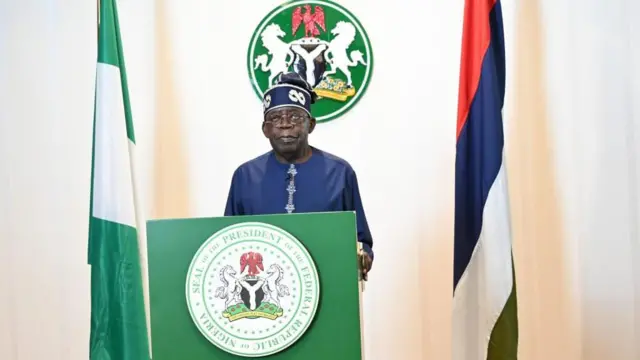
President Bola Tinubu has declared that the harshest phase of his economic reforms is over, saying Nigeria has moved from an “age of reform” into an “age of prosperity.”
Tinubu stated this in his Independence Day broadcast to Nigerians, themed “From Reform to Prosperity,” as the country marked its 66th Independence Anniversary.
The President defended the removal of petrol subsidy and the unification of the naira exchange rate, saying the reforms confronted long-standing weaknesses in the economy.
“Nigeria was like a sick patient who receives the terrible news that he has cancer,” Tinubu said. “His doctor explains that the treatment will be difficult and painful, but that it offers a strong prospect of recovery.
“The patient has a choice. He can begin treatment, endure its discomfort and fight the disease. Or he can ask only for morphine, dull the pain and leave the cancer to spread.
“For too long, Nigeria’s leaders chose morphine while praying for a miracle that never came.”
The President also warned against calls to restore fuel subsidies, saying such proposals could reverse the gains of the reforms.
“Now, as certain influential but regressive voices would have us abandon the treatment and return ourselves to the abuse of addictive subsidies, we must resist their siren song,” he said.
“We must remember why we began this journey and how far we have already come.”
Tinubu said the reforms did not create Nigeria’s economic difficulties but confronted them.
“Our reforms did not create the weaknesses in our economy. They confronted them,” he said.
According to him, the economy grew by more than four per cent, with both the oil and non-oil sectors contributing to what he described as renewed stable growth.
He said oil theft had declined, inflation had fallen substantially from its peak, foreign reserves had been rebuilt and the foreign exchange market had stabilised.
Tinubu also said Nigeria recorded its highest-ever revenue from non-oil exports in 2025, exceeding six billion dollars.
“This is real money being made by real Nigerian businesses,” he said, adding that international observers, journalists, non-governmental organisations and multilateral institutions had recognised improvements in Nigeria’s economic stability and resilience.
Declaring a change in the administration’s economic priorities, Tinubu said the country’s central task had shifted from correcting its economic course to delivering shared prosperity.
“The emergency treatment is over. The foundation has been repaired,” he said.
“For three years, our overriding purpose was to correct our nation’s course. Now, our purpose is simple: shared and widespread prosperity.”
He said prosperity should be reflected in the lives of ordinary Nigerians through improved agricultural production, reliable electricity for factories, access to credit, productive jobs and the ability of families to afford food, transportation and education.
On the cost of living, Tinubu said the administration would focus on reducing the cost of producing and transporting goods.
He listed plans to expand mechanised irrigation and dry-season farming, improve access to seeds and fertiliser, increase agricultural mechanisation and invest in storage, transportation, roads, railways and ports.
“Our logic is simple,” he said. “When a farmer produces more cheaply, when fewer crops are lost between the farm and the market, when a manufacturer spends less on electricity, when a truck reaches its destination faster, and when the business environment fosters fair competition, all those savings will ultimately find their way into the price of goods in the market.”
Tinubu said jobs, enterprise and industrial growth would form the centre of the next phase of his administration, with emphasis on domestic gas, industrial revival, digital connectivity and skills development.
“I want to see more Nigerians making things,” he said.
“I want to see more Nigerian farms feeding our cities and supplying our factories. I want to see Nigerian businesses selling Nigerian goods to the whole world. I want young Nigerians building unicorns and creating opportunities for others here at home.”
The President also acknowledged that millions of Nigerians could not wait for long-term economic gains, saying his administration was strengthening social intervention programmes.
He cited the Nigerian Education Loan Fund and the Consumer Credit Corporation as part of measures aimed at supporting low-income families and working Nigerians.
“These programmes are not substitutes for prosperity. They are a bridge,” he said.
“Our objective is not to manage poverty more efficiently. We will defeat it.”
Tinubu said salaries and pensions had been paid on time and in full since 2023, while reforms in the national pension system were designed to benefit retirees and vulnerable Nigerians.
Concluding the broadcast, the President used the biblical account of the Israelites’ exodus from Egypt to describe the country’s economic journey.
“Nigeria has corrected its course. We have passed through our own Red Sea. This is not the time to look back,” he said.
“Our destination is in sight. Our foundations are strong. Our direction is clear. So let us go forward. No looking back.”
Punch
![US publishes names, photos of 24 Nigerians to be deported [FULL LIST]](https://frontlineafrica.com.ng/wp-content/uploads/2026/10/united-states-flag.jpg)