ENUGU — The authors of a new book on the Nigerian Civil War have said the publication is intended to serve as a mirror for reflection, healing and national unity, rather than reopen the wounds of the 1967-1970 conflict.
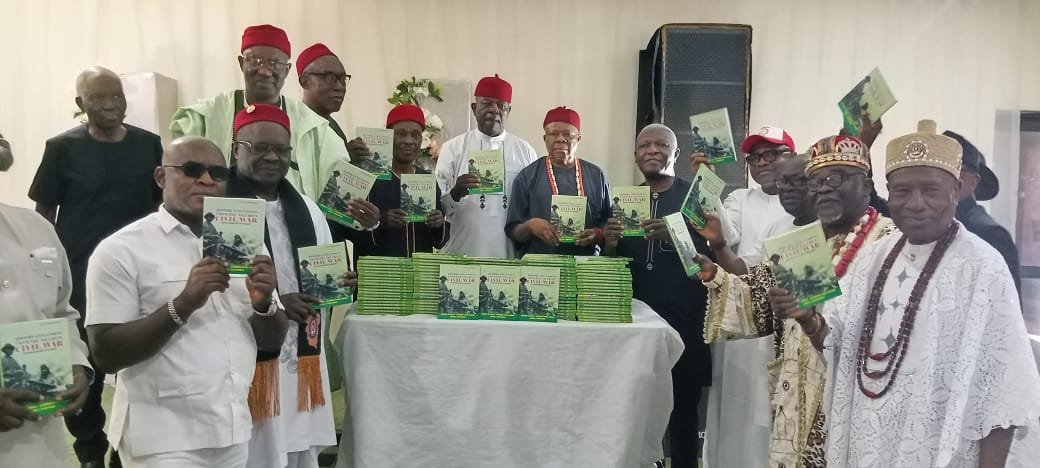
The three authors — Chief Obioma Ikechi, a publisher, Dr Uchenna Anioke and Chief James Egwuonwu — stated this at the unveiling of their book, History and Lessons from the Nigerian Civil War (Chronologically Arranged), in Enugu.
Speaking on behalf of the authors, Anioke said the publication was an attempt to present the history of the war objectively and chronologically, while drawing lessons that could help present and future generations avoid the consequences of violent conflict.
He said the history of the Civil War had often been presented in fragments, surrounded by silence or interpreted from partisan perspectives, leaving many young Nigerians without a clear understanding of the events that preceded and shaped the conflict.
Anioke said the authors therefore chose a chronological approach to provide readers with a structured account of the developments that led to the war and its eventual conclusion.
“When three of us — Ikechi, Uchenna and Egwuonwu — sat down to begin this project, we asked ourselves a critical question: how do we tell a painful history objectively so that it heals rather than divides?
“Our answer was structure and chronological accuracy. By arranging these historic events strictly by date, from the early rumblings of 1966 to the final declarations of 1970, we avoided political distortion,” he said.
He said the book provided a step-by-step account of the crisis and its underlying developments, stressing that a nation could not build a stable future by forgetting or distorting its history.
According to him, the publication is designed to promote national unity, strengthen institutional memory and encourage Nigerians to reflect critically on the country’s past.
He said students, policymakers and members of the public interested in Nigeria’s history, peace and national development would find the book particularly useful.
Anioke said the central lesson of the Civil War was that peace required a conscious choice, urging Nigerians to embrace dialogue, empathy and unity in resolving differences.
“The lessons of the Civil War teach us that peace is a deliberate choice. We hope this book inspires you to choose dialogue, empathy and unity every day.
“Our book is not a weapon meant to reopen old wounds of the Civil War. Rather, it is meant to be a mirror to reflect our shared responsibility and historical heritage,” he said.
Representing Gov. Peter Mbah of Enugu State, the Commissioner for Environment, Prof. Sam Ugwu, said history remained essential to understanding the past and making informed decisions about the future.
Ugwu described the book as an important documentation of the remote and immediate causes of the Civil War, as well as its socio-economic and political consequences.
He advocated the restoration and strengthening of history as a subject in Nigerian primary and secondary schools, describing the removal or weakening of history education as dangerous.
The commissioner urged curriculum planners to ensure that Nigerian children were adequately taught the country’s history, saying knowledge of the past was necessary for building a more informed and united society.
He commended the authors for documenting the conflict and urged Nigerians to read the book and draw lessons from the experiences of the war.
The Chairman of the event and Managing Director of COPEN Group, Ugochukwu Chime, said a strong sense of history was necessary for citizens to understand the present and make informed choices about the future.
Chime urged Nigerians not to stop at the presentation of the book but to read it critically and draw practical lessons from the experiences documented in it.
Recalling his experience during the Civil War, he said he survived a bombing incident during which he was carried and thrown into a ravine, while several members of his family were killed.
He commended the authors for their collaboration, saying collective efforts to document history and promote understanding were important to the development of Igboland and Nigeria.
Reviewing the book, Dr Ambrose Igbokwe, Chairman of the Public Affairs Analysts of Nigeria, Enugu State chapter, said the publication was particularly relevant to younger Nigerians who did not experience the war.
Igbokwe said he had read several books on the Nigerian Civil War but found the chronological arrangement of the new publication particularly useful in following the sequence of events.
He said the book traced Nigeria’s development from the colonial period through independence, the political crises and military coups that preceded the Civil War, and the developments that culminated in the conflict.
Igbokwe cautioned against romanticising war, particularly through films, social media and other forms of popular entertainment that might present conflict without adequately portraying its human cost.
He said the devastating consequences of war should serve as a warning to younger generations and reinforce the need for dialogue and peaceful resolution of disagreements.
The book presentation attracted academics, traditional rulers, public officials, journalists and other stakeholders, who examined the publication’s account of the Civil War and its broader lessons for contemporary Nigeria.
![US publishes names, photos of 24 Nigerians to be deported [FULL LIST]](https://frontlineafrica.com.ng/wp-content/uploads/2026/10/united-states-flag.jpg)