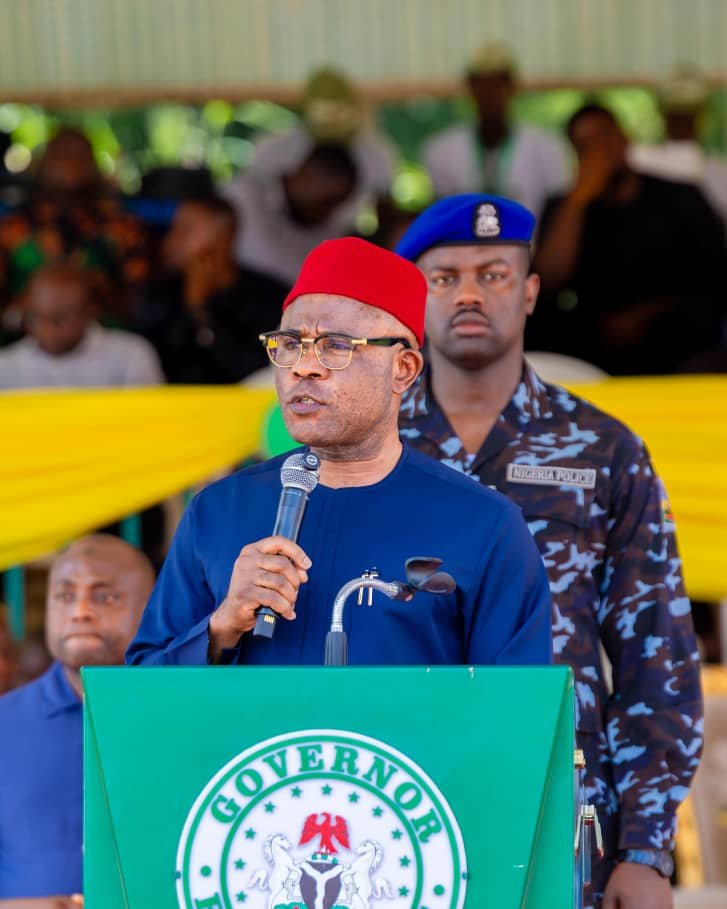
Gov. Peter Mbah of Enugu State says his administration opted to build new Smart Green Schools rather than renovate existing schools because the state needed a fundamental transformation of its education system.
Mbah stated this on Wednesday at the Enugu Education Summit, organised by the state Ministry of Education at the International Conference Centre, Enugu.
He said renovating classrooms, supplying desks and installing computers in existing schools would amount to incremental improvement and would not adequately prepare children for the demands of the modern world.
“We could have repaired the existing system. We could have renovated some classrooms, supplied some desks, put computers into a few schools and called it reform.
“But we had to ask ourselves a more difficult question: Would it be enough?
“Would an education system essentially designed for the world of 40 years ago prepare our children in Enugu for the world we are in now, or the world 20 years from now?
“Our answer was a resounding no,” Mbah said.
The governor said the administration therefore decided to rethink education and committed to building 260 Smart Green Schools, one in each electoral ward.
He said the schools were deliberately located beyond urban centres to give children in communities that had historically suffered geographical and socioeconomic disadvantages access to quality education.
Mbah said more than 7,000 classrooms had so far been constructed under the programme, while the state had also shifted from traditional learning to experiential learning.
He said the new approach emphasised problem-solving, collaboration, critical thinking, digital capability and practical application of knowledge rather than memorisation.
The governor said the state had demonstrated its commitment to education through increased funding, with approximately one-third of its budget allocated to the sector for three successive budget cycles.
He said the investment was driven by the conviction that education was central to tackling poverty and creating opportunities for citizens to acquire knowledge and skills to create wealth and participate meaningfully in society.
“If we’re serious about ending poverty, we have to get to its roots. For us, one of those roots is lack of knowledge.
“Whatever education costs us today, ignorance will cost us far more tomorrow,” he said.
Mbah said the education reforms had attracted the attention and support of development partners, including UNESCO and UNICEF.
He said the partnerships had assisted the state in developing its education policy, operational plans and implementation guidelines in line with global best practices.
Earlier, the UNESCO Representative to Nigeria, Dr Isaías Barreto da Rosa, commended the Enugu Government for its investment in education, particularly the Smart Green Schools and experiential learning initiative.
Barreto da Rosa, represented by the Head of Education Sector, UNESCO Abuja, Mr Oladeji Adeyemi, said the schools demonstrated that education infrastructure could be digitally enabled while remaining environmentally responsible.
He said UNESCO was pleased to support the state’s efforts to digitise experiential learning models and make quality learning accessible to more children.
The UNESCO representative also commended the state’s plan to recruit more than 6,000 additional teachers, noting that the world faced a projected shortage of about four million teachers by 2030, while sub-Saharan Africa would require about 15 million.
Also, the UNICEF Representative to Nigeria, Ms Wafaa Abdelatef, represented by the UNICEF Enugu Field Office representative, Ms Juliet Chiluwe, congratulated the state government on its commitment to transforming education.
Abdelatef said education transformation was ultimately about ensuring that every child was in school, learning, safe, healthy and prepared for the future.
She said UNICEF had supported the development of the state’s education policy, Education Sector Plan, and State and Local Education Sector Operational Plans for 2026-2028.
She urged the state government, development partners, local governments, school leaders and communities to remain focused on translating the plans into measurable results.
The Commissioner for Education, Prof. Ndubueze Mba, said the British Council, UNICEF, UNESCO, technical partners and business partners had come together to validate and support the state’s education reforms.
He said the policy documents were designed to ensure that the reforms remained sustainable and were not reversed by future administrations.
The commissioner said the summit provided an opportunity for development partners and education stakeholders to endorse the state’s approach and support its implementation.
![US publishes names, photos of 24 Nigerians to be deported [FULL LIST]](https://frontlineafrica.com.ng/wp-content/uploads/2026/10/united-states-flag.jpg)